

Nomi Notes: Volume 3
AI Deployment Accelerates, Defense Re-Arms and Fintech Eyes the Public Market

We recently celebrated the one-year anniversary of Nomi Capital! Since our founding we’ve made 11 investments, deployed $30 million and celebrated our first IPO with CoreWeave.
On the personnel front – we’re hiring! And in May, our founder welcomed a baby girl to the world.
This edition of Nomi Notes covers key trends across capital markets, AI, defense tech, fintech.
Nomi Portfolio Update
We’re proud of the portfolio we’ve built over the last year. The CoreWeave IPO in March marked a major milestone and the stock now trades at roughly 3.8x our entry point from last fall.
Several other positions have also appreciated – some significantly – and we’re seeing strong momentum across the board.
Here is an update on our current investments:

Public and Private Markets Evolve
Private companies are staying private far longer than in previous decades – experiencing much of their growth in value before ever hitting the public markets.
Decades ago, companies would IPO at earlier stages and lower valuations, giving public market and retail investors more opportunity to participate in the upside.
Today, that dynamic has flipped: the most successful startups often don’t debut until they’re already giants, capturing the bulk of gains for private investors while leaving relatively less growth for the retail public.
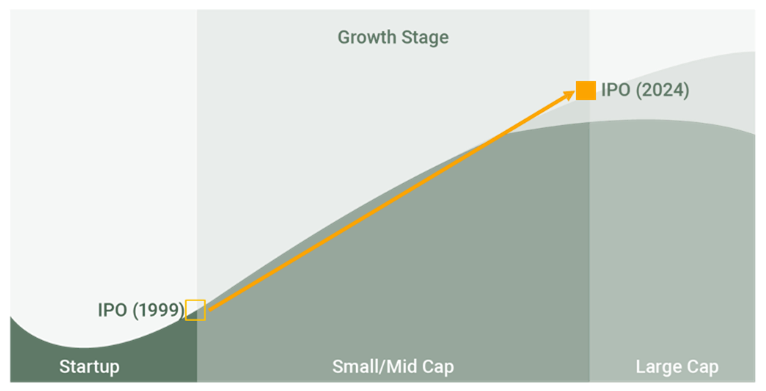
A few stats that highlight this shift:
· The number of public companies has shrunk by half since the late 1990s
· 87% of companies with over $100 million in revenue are private
· The average age of a technology company at IPO has increased from 4.5 years in 1999 to 12+ years in 2020.
Then vs. Now: Tech IPOs

Nomi's Take: Retail investors have fewer chances to access fast-growing companies early. Those looking to participate in innovation and compounding growth must turn to the private markets. For those willing to accept illiquidity, we believe late-stage venture offers exceptional risk/reward. A core pillar of our mission at Nomi is unlocking access to these opportunities.
CoreWeave Validates Our AI Infrastructure Thesis
CoreWeave has become a bellwether of the AI trade on the way up and down.
Their IPO in March priced below expectations, amid fears about DeepSeek’s open-source release and tariff uncertainty.
As we wrote then, we believe the implications of DeepSeek were deeply (pun intended) misunderstood.
Since then, looking at CapEx guidance from the hyperscalers and listening to earnings calls has reinforced our conviction – demand for AI compute, especially inference, is exploding.
Amazon: "As fast as we add capacity, it's being consumed. Demand is outpacing supply – we simply can't build AI fast enough."
Meta: "Even with the capacity that we're bringing online in 2025, we are having a hard time meeting the demand that teams have for compute resources across the company."
Microsoft: “While we continue to bring data center capacity online as planned, demand is growing a bit faster…we now expect to have some AI capacity constraints beyond June.”
NVIDIA: "Reasoning models are driving a step-function surge in inference demand."
Broadcom: "Inference has come out very, very hot lately... we're seeing much more inference now."
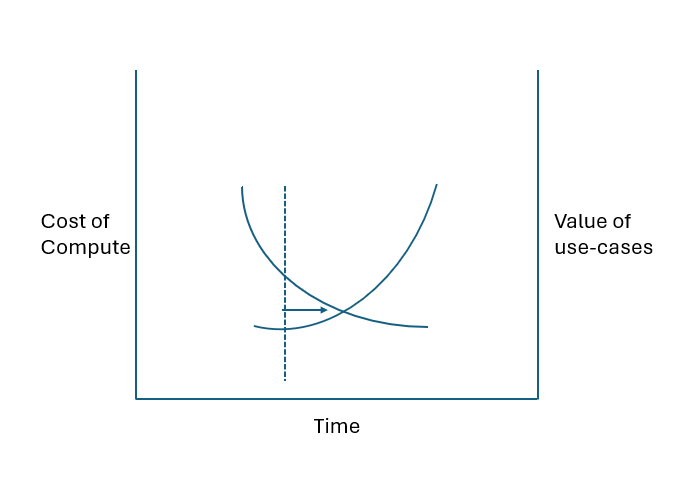
CoreWeave’s +360% post-IPO rally has confirmed the thesis. The DeepSeek release didn’t break the AI trade, but rather, it accelerated a critical unlock: cost reduction.
The cost of tokens (i.e. using models) has come down dramatically, with OpenAI token pricing down 87% year-to-date. This, in turn, results in growing usage.
Nomi's Take: We believe we’re still in the early innings of the AI Infrastructure cycle. Inference demand is just beginning and companies like CoreWeave and Groq are poised to lead this next wave of infrastructure growth. This isn’t the end of the AI buildout. It’s the shift from hype to scale, enabled by continued reduction in costs.
Defense Tech Momentum Accelerates
Fears of defense budget cuts from earlier in the year have more recently turned to a proposal for $1 trillion of defense spending next year.
But the story is less about the overall budget and more about a repositioning that is underway – from large, legacy systems toward drones, autonomy, electronic warfare and low-cost deterrents.
Real-world lessons from Ukraine and the Red Sea and increasing tensions in the Indo-Pacific have made clear that U.S. military capabilities and systems must evolve.
China and Russia’s rapid progress in autonomous systems, hypersonics and electronic warfare has created urgency in Washington – not just for funding, but for faster procurement and more agile innovation. We discussed the importance of this earlier in the year.
Nomi's Take: Our portfolio companies – Epirus (counter-drone systems), Shield AI (autonomous software and drones) and Saronic (autonomous surface vessels) – are part of this modernization wave. After years of inertia, the procurement machine is finally moving and funding is tilting towards emerging defense neo-primes.
Fintech Summer?
Following the recent IPOs of Circle, Chime and eToro, there’s a wave of late-stage fintech companies creeping toward the public markets: Brex, Gemini, Klarna, Kraken, Navan, Ramp and Stripe, among others.
Many of them have built real businesses with scale, margins, and network effects, but their business models are often hard to categorize. Are they banks? Payment companies? SaaS? Some blend of all three?
Valuations will depend on how investors answer this question.
Nomi's Take: We expect a mixed reception: Fintechs that have reasonable valuation expectations and are able to successfully tell their story should perform well. But those that try to dress up a business model with a SaaS or AI narrative – when the financial statements tell a different story – may face a harsh audience in today’s more disciplined public markets.
What we’re reading lately:
"How the Houthis Rattled the U.S. Navy – and Transformed Maritime War" (WSJ, June 2025)
"No Rivals: The Founders Fund Story" (The Generalist, June 2025)
"This Giant Microwave May Change the Future of War" (MIT Technology Review, May 2025)
“DeepSeek’s ‘Tech Madman’ Founder Is Threatening US Dominance in AI Race” (Bloomberg, May 2025)
“Defense Tech Boom: Autonomous Drones, Lasers, And Hypersonic Missiles” (Forbes, June 2025)
We welcome your thoughts!
Jason Zins
Founder & Managing Partner