Breaking Up OpenAI
The clock is ticking on OpenAI’s conversion to a for-profit entity. It’s time for it to break up.

"OpenAI is not a model company, it's a product company that happens to have fantastic models at this point.”
CEO of Microsoft, Satya Nadella, the closest partner and benefactor of OpenAI.
Satya’s words should become reality. It’s time for OpenAI to break up.
The $20 Billion Catalyst
As part of OpenAI’s massive $40 billion equity raise that valued the company at $300 billion in the largest private funding round in history, OpenAI must convert to a for-profit entity by the end of the year or they’ll lose out on half of the capital.
Even before this round, in December 2024, OpenAI announced plans to restructure as a for-profit public benefit corporation under increasing pressure from investors and controversy related to its status as a nonprofit.
While public details of their plans are limited, the company said the restructuring aims to separate its commercial and charitable activities, with the for-profit entity overseeing operations and the nonprofit focusing on charitable initiatives in areas like healthcare and education.
OpenAI should take a bolder step: split into a for-profit product company and an open-source, nonprofit research organization.
Identity Crisis
OpenAI has become the epicenter of artificial intelligence innovation, but it’s burning through billions developing AI models while simultaneously building commercial products, all while attempting to stay true to its original mission of benefiting humanity.
The company has an identity crisis.
Its current structure – a hybrid of for-profit and nonprofit elements – forces OpenAI to balance conflicting priorities: maximizing shareholder value while advancing research for societal benefit.
By disentangling these objectives, each entity could pursue its goals without compromise. The for-profit side could innovate faster in product offerings with a more sustainable business model, while the open source, nonprofit research organization could pioneer developments that benefit the broader AI community, consistent with its founding mission.
“Advancing digital intelligence in the way most likely to benefit humanity as a whole, unconstrained by a need to generate financial return.”
-Original OpenAI Mission Statement
Unlocking Value Through a Strategic Split
Here’s how it would work:
The AGI Trust (Nonprofit)
Focuses on fundamental AI research and open-source model development.
Funded through philanthropy, government grants and a minority stake in the product company.
Maintains independence while contributing to the broader AI ecosystem.
OpenAI (For-Profit)
Develops commercial applications and services.
Free to use models from multiple providers, optimizing for specific use cases.
Clearer path to profitability without research overhead, attractive to traditional software investors.
To retain value from its investment in model development, a time constrained agreement for advanced or priority access to new models could be entered into with the nonprofit.
The primary benefits of this new model:
Preserve OpenAI's original mission – Keeping the model business as a nonprofit and shifting to open source ensures that fundamental AI research remains aligned with public benefit rather than short-term profits.
Sam Altman recently hinted he might agree with this approach:
Altman stated that he believes OpenAI has been “on the wrong side of history” when it comes to open sourcing its technologies and believes that the company needs to “figure out a different open-source strategy.”
Ensure sustainable AI research – The nonprofit can sustain itself through a 10%-25% minority stake ($30-$75 billion at current valuation) in the product business, enterprise licensing deals, as well as a combination of philanthropy and public funding.
Again, Altman seems to agree:
"We thought we were going to be a research lab. We literally had no idea we were ever going to become a company... If I knew everything I knew now, of course we would have set it up differently."
Enable product flexibility – A standalone product company could integrate third-party AI models that may be better suited for specific use cases, creating better experiences for users and reducing dependency on a single provider.
In a world where AI model rankings change on a weekly basis and consumers can barely tell the difference between them, the real value lies in building products people love.
In a recent podcast, Microsoft CEO Satya Nadella said that he believes: "the models are getting commoditized."
Create a more attractive business model – As models continue to commoditize, focusing resources on building consumer and enterprise products is the key to building a sustainable and profitable business.
It doesn't require nearly the same level of capital expenditure and OpenAI could operate more like a traditional software company, iterating on user experience, pricing models and integrations.
Training state-of-the-art AI models requires an enormous amount of capital and is expected to drive massive losses of up to $44 billion for OpenAI from 2023-2028. As it currently stands, the company doesn't expect to achieve profitability until 2029, when it projects $125 billion in revenue.
Conclusion
In 2019, OpenAI released its last open-weight model. It’s been closed ever since.
It’s time to return to its namesake.
By keeping the model business as a nonprofit while spinning off the product business, OpenAI can realign with its founding vision. The nonprofit would focus exclusively on advancing AI research and developing open models for public benefit, while the product company would operate independently, driving innovation and commercialization without mission-related constraints.
AI is still in its early innings and the market structure we define today will shape its future. By breaking up OpenAI, we can create a more competitive, dynamic AI industry – one that benefits users, businesses, investors and society at large, while staying true to OpenAI’s founding mission and setting up a sustainable business for its investors
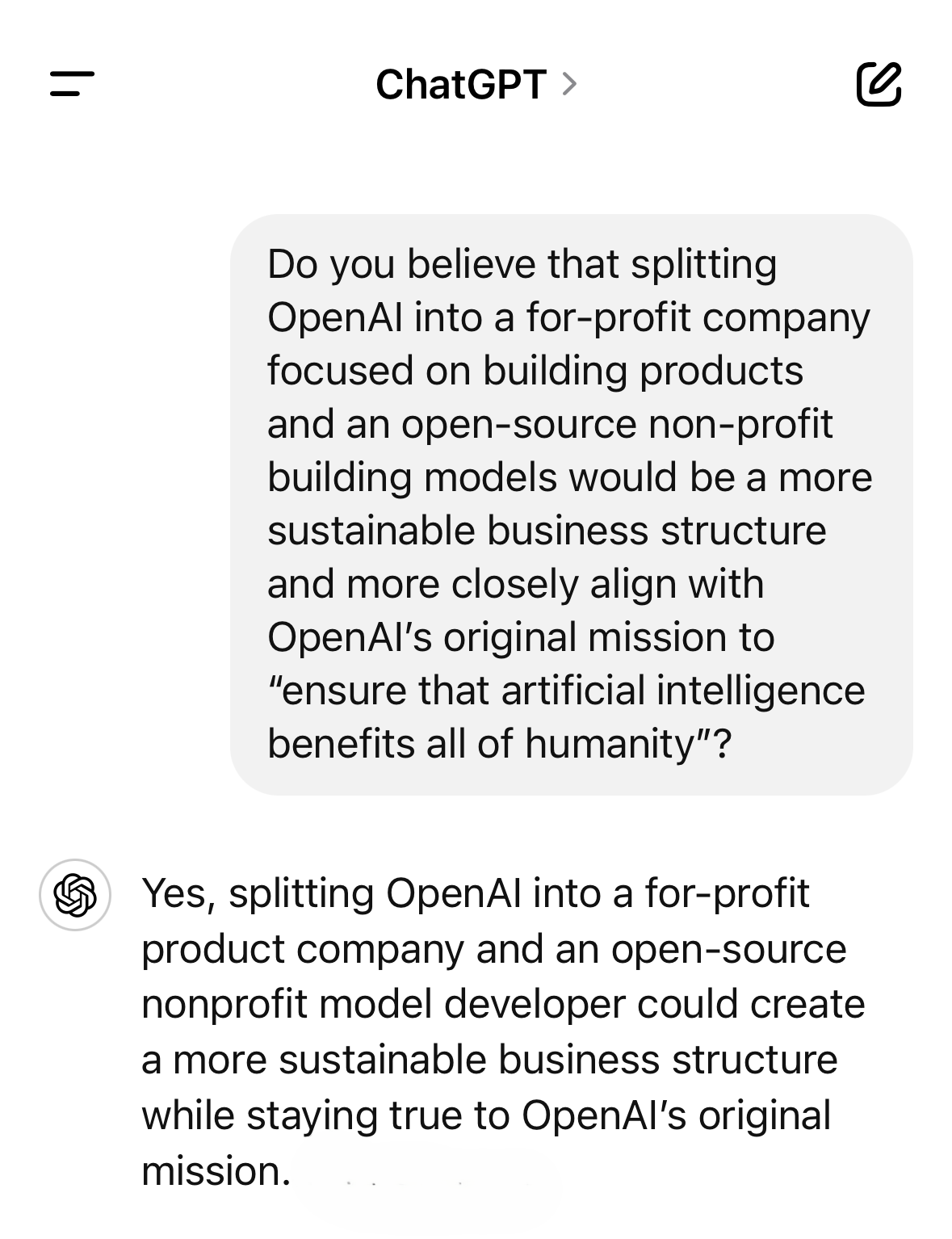
If you don’t believe us, just ask ChatGPT: